 |
      
|
 |
The IncorruptiblesWe turn our skeptical eye on claims of incorruptibility - bodies that do not decay after death. Skeptoid Podcast
#126 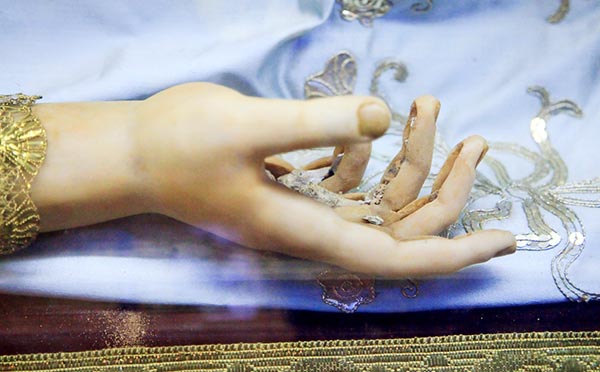 Lightning flashes as we scrape the final shovelfuls of dirt away from the top of the coffin, pry open the lid, and in the lantern light we see a perfectly preserved human body! It's as if she died only a few hours ago, but this body we're exhuming is centuries old. How can this be? How can this body have proven incorruptible by decay and the ravages of time? According to the Catholic faith, such incorruptibility is a miracle. A person who dies and proves incorruptible can thus qualify as a saint. There are quite a few alleged examples of this, and we'll take a look at some of the best known. But first, let's examine exactly what the church's criteria are for incorruptibility. In essence it means that the body does not decompose after death, in a miraculous manner not explainable by natural processes. The body has to remain flexible and is supposed to be indistinguishable from sleep; it can't dry out like an Egyptian mummy and be all stiff. The body also must not have been embalmed or otherwise preserved. The most famous of the Catholic incorruptibles is Saint Bernadette, currently on display at the Chapel of St. Bernadette in France. She died in 1879 and was exhumed thirty years later, so the story goes, and was discovered to be incorrupt and free of odor! However, two doctors swore a statement of their examination of the body, clearly describing a partially mummified corpse, describing the whole body as "shriveled", saying the lower parts of the body had turned black, the nose was "dilated and shrunken", and that the whole body was rigid and "sounded like cardboard when struck." The body was prepared and reburied in a sealed casket. When it was dug up again in 1919, another doctor filed the following report:
At her third and final exhumation in 1925, it was noted that the "blackish tinge to the face and the sunken eyes and nose would make an unpleasant impression on the public," and so the decision was made to display the corpse with a wax mask. That's right, the photos you see on the Internet of St. Bernadette's beautiful, incorrupt corpse are of a wax mask placed on an obviously mummified body. The descriptions of her condition openly violate all the requirements of incorruptibility, and yet St. Bernadette is the most often cited example of miraculous incorruptibility. When you think about it, if a saint dies and God decides that this body should be incorruptible, you'd think it should remain absolutely perfect, like Sleeping Beauty. It shouldn't be only slightly less decomposed than the average body, and certainly shouldn't be a common mummy. St. Catherine of Bologna is another nun whose supposedly incorrupt body is still on display. She died in 1463, and although I couldn't find any documentation at all pertaining to the circumstances of her burial and exhumation, the story goes that she was buried without a coffin and was exhumed only 18 days later due to a strong sweet scent coming from her grave — more about that in a moment. Her body is displayed at the chapel of Poor Clares in Bologna, Italy, in a seated position inside a glass case. As you can see from the many photos on the Internet, the body is completely mummified, black and shriveled, and can by no definition be called incorrupt. And yet she is called just that anyway, in utter defiance of the blatantly obvious. Saint Silvan was a young man said to have been killed for his faith in the year 350, and his body is on display in Dubrovnik, Croatia, replete with a fresh-looking gash on his throat said to have been the cause of death. The body appears to be perfect. It is a sculpted effigy — St. Silvan's actual remains are said to be contained within the box below the effigy. But there is no display signage to explain this to the faithful, and many come away with photographs of what they think is the actual body. If he is incorrupt as the church claims, why display the effigy instead of the body? Padre Pio, the 20th century priest famous for his stigmata, is also on the church's list of incorruptibles. However, according to the church's own records, his body was embalmed with formaldehyde upon death. Even so, at his exhumation 40 years later, the remains were described as "partially skeletal" and morticians were unable to restore the face to a viewable condition, so Padre Pio is displayed today with a lifelike silicone mask. Incorruptible bodies, when exhumed, are often said to be accompanied by a sweet odor which Catholics called the Odor of Sanctity. This odor is also said to come from stigmata on living saints. Some saints are said to have exuded this odor after death. Of course the obvious explanation for such a smell would be embalming fluid. However, modern embalming fluids, basically formaldehyde mixtures, are said to have a strong, unpleasant smell like gasoline. Therefore most manufacturers mask the smell with perfume additives. Historically, sweet-smelling ointments were used on corpses to counter the smell of decomposition, and many such ointments are now known to have contained guaiacol, an effective preservative made from beechwood tar, similar to creosote. So, dig up a body and find it in any state of preservation, and you're likely to smell a strong sweet odor. Evidence of embalming or odor-masking is a better explanation for this smell than some supernatural "Odor of Sanctity". The best examples of natural incorruptibility come from the peat bogs of northern Europe. About a thousand individuals have been exhumed from the bogs, where a unique combination of cold conditions and chemical processes preserves the soft tissues. Most of these come from the Celtic iron age, but some are far older; the oldest being Koelbjerg Woman who is 5,500 years old. In bog bodies, peat acid actually dissolves the bones but leaves the soft tissues pliable, like rubber, though stained brown and actually tanned into leather. Technically, these bodies meet the Catholic criteria of incorruptibility far better than any of the dried mummified corpses that the church claims. Why are the bog people not considered saints? At least their bodies actually do remain flexible. The church probably says that the natural chemical process counts as embalming, which of course it does; but at least this is a natural process and not a deliberate human embalming as has happened with so many of the so-called miraculous Catholic incorruptibles. Most recent is the case of Hambo Lama Itigelov, a Buddhist monk who died in the Russian Mongol territory of Buryatia in 1927 and was exhumed in 2002, by his own last request. His condition was described by the monks and a pathologist in attendance as that of someone who had died only 36 hours before. Video shows what looks to be a well-preserved mummy, but hardly that of someone who died only 36 hours before. His body is on display in the open air and is claimed to remain pliable, a claim which is untested. Despite a Russian documentary movie finding no explanation, and the monks' claims to the contrary, the pathologist's own report found the body to have been preserved with bromide salts. Itigelov had also instructed that his body be packed in salt, another way to help prevent decomposition by absorbing moisture away from the body. It's interesting that in life, Itigelov actually had a degree in medicine, and had written a Buddhist encyclopedia on pharmacology. Buddhist monks have long practiced self-mummification. Some Japanese monks used to prepare themselves for self-mummification through a technique called sokushinbutsu. They ate a subsistence diet of nuts and seeds for 1000 days to get rid of all their fat, and then spent the next 1000 days eating only bark, roots, and drinking the tea of a poisonous tree called the urushi, in an effort to make their body both dehydrated and toxic to parasites. Finally they would place themselves inside a stone tomb, ringing a bell once each day. When the bell failed to ring, the other monks would seal the tomb, wait another 1000 days, and then open it up to find out whether the monk had mummified. Only about 20 such monks were successfully mummified in this manner; the rest decomposed normally. Even this number is impressive given that the internal organs remained, which are a prime source of bacteria that contribute to decomposition. Tests of the mummies have revealed toxic levels of arsenic, which is another embalming agent. Together with the lack of body fat and pre-existing dehydration, monks practicing sokushinbutsu actually had a reasonable chance of mummification if their tomb was well sealed and conditions were dry. Hambo Lama Itigelov's own technique of using bromide salts and salt packing appears to be a scientifically updated form of sokushinbutsu. But you couldn't call these monks incorruptible any more than you can use the term to describe the Catholic saints who are obviously mummified. Mummification is the natural, expected process that happens to a body under the right conditions. There's nothing miraculous about a natural, expected process. I suppose some people claim that in some of these cases, decomposition should have taken place instead of mummification, and thus the miracle. So, what; leaving a few strands of beef jerky stretched over the bones is the best that the miracle-creating superbeing was able to muster? I'm not convinced, and a skeptical Catholic shouldn't be either. Incorruptible should mean incorruptible. The corpse needs to be flexible and lifelike, as if asleep. We've never seen anything remotely like that. There are no verifiable, viewable examples of supernatural incorruptibility anywhere on the planet, and no reason to think there ever have been.
Cite this article:
©2024 Skeptoid Media, Inc. All Rights Reserved. |