 |
      
|
 |
Will the Large Hadron Collider Destroy the Earth?Skeptoid Podcast
#109 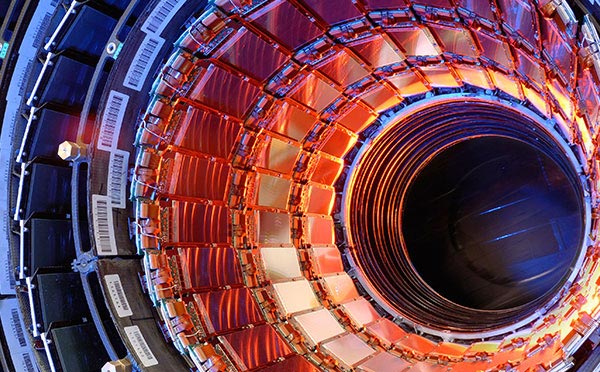 Imagine a $10 billion underground ring-shaped tunnel, 27 km in circumference, so big that it stretches through both France and Switzerland: One ring to rule them all, the new Large Hadron Collider at the European Organization for Nuclear Research, better known as CERN, scheduled to come online around about August 2008. A collider is the basic tool of particle physics. You take a stream of particles, accelerate them to really high kinetic energy levels, and slam them into a target. Depending on the experiment, all sorts of exotic things happen. Most experiments are to create new particles predicted by theory or to examine their behavior. The Large Hadron Collider, or LHC, has two beams traveling in opposite directions around the 27 km circle, each accelerated to 7 TeV (trillion electron volts) of energy and traveling at 99.999999% of the speed of light, held in place by powerful magnets. All around the ring are different experiment stations. To perform an experiment, you turn on the experimental detector and use the magnets to collide the beams into each other head-on inside your detector, creating 600 million 14 TeV collisions per second. That's a pretty high energy level, and we expect to learn all sorts of new and exotic things about the universe. Most famously, we hope to find the theorized Higgs boson, the particle that creates mass; but the collider's various experiments will produce knowledge that will permeate virtually every science we have. As you may have heard by now, some people have voiced concerns that particle collisions from the LHC will create tiny black holes. Black holes have such intense gravity that they consume everything around them, even light. And so, within a fraction of a second, this tiny black hole will consume the collider itself, France, Switzerland, and then the entire Earth, presumably followed shortly thereafter by our whole solar system. Clearly not a fear to be taken lightly. The best known opposition to the Large Hadron Collider comes in the form of a much publicized lawsuit, filed in Hawaii by two individuals, science writer Luis Sancho and retired nuclear safety officer Walter L. Wagner, against the US Department of Energy, Fermilab, CERN, the National Science Foundation and Does 1-100. The lawsuit presents affidavits from the plaintiffs and five other individuals, stating their opinion that dangerous black holes could be formed and seeking to block operation of the collider until these fears can be adequately studied. It seems a reasonable precaution, given how incredibly gigantic and powerful the LHC is, and how Biblical the scale of the destruction it might wreak. Yet, the Large Hadron Collider is but a donut compared to what the United States' Superconducting Supercollider would have been. The SSC, as it was known until its cancellation in 1993, would have had a circumference of 87 km and a beam energy of 30 TeV — that's more than three times the size of the LHC and more than twice the energy. And even the mighty SSC was but a Cheerio compared to the hypothetical Very Large Hadron Collider proposed by Fermilab, with a circumference of 105 to 650 km, and a beam energy of 40 to 200 TeV! So when you compare the LHC to other possible colliders, you realize that yeah it's crazy big, but it's not that big and it's nowhere near the energy levels that are possible. It's certainly not the "ultimate doomsday device" that some fearmongering detractors are making it out to be. And, even after looking at other possible larger colliders, if you're still concerned that 14 TeV represents the pinnacle of danger, just look at the naturally occurring collisions happening all around us every day. Cosmic rays in the LHC's energy range are hitting the atmosphere constantly, and have been for 4 billion years, creating the same type of collisions that the collider will produce. Some of these, called Ultra High Energy Cosmic Rays, have been measured at over 1020 electron volts, ten million times as energetic as the LHC's maximum energy. While that sounds like a staggering amount, it's about the kinetic energy of a baseball thrown at 100 kph. That's a lot for a single proton, but it's hardly the destruction of the planet. So one way to think of this is that the Large Hadron Collider is just an impotent little Spaghetti-O compared to the greatest supercollider of them all: The universe. Nature's supercollider has been going for billions of years at energies millions of times higher than human scientists can dream about. So far, neither Earth nor any of the other planets, nor even any super-dense astronomical bodies like neutron stars, have suffered from particle collisions. In fact, according to Dr. Brian Cox at CERN, the universe conducts the equivalent of ten trillion lifetime runs of the LHC every second, and has been doing so for billions of years, with not a single observable consequence. The main reason is that micro black holes of the type that particle collisions can create behave very differently than the giant supernova-sized black holes you see in movies. They don't eat anything. Instead, they explode with a tiny little micro pop. Most people have heard of Hawking radiation, which is emitted by black holes. As large black holes eat stuff, they also evaporate away as Hawking radiation. The smaller the black hole, the more energetic this evaporation. For a micro black hole, this evaporation happens at essentially the same instant it is created, or at least, this is what is theorized: Specifically, they would decay instantaneously into hadron jets and high PT leptons, which are one thing that we actually hope to see with the LHC. As for Sancho and Wagner's concerns, they are not the first people to conceive of these events; and whether they like to think so or not, the subject has already been studied — exhaustively, in fact — and it's been part of the plans since many years before they contrived their little lawsuit. In fact, four years before Sancho and Wagner filed their lawsuit, CERN completed its report based on decades of research into the safety of the collider, which concludes:
As a backup in case their black hole alarmism should fail, Sancho and Wagner also proposed a danger from strangelets created by the LHC. Strangelets are unusual particles composed of an eclectic mixture of similar numbers of up, down, and strange quarks. This so-called strange matter is one candidate for the dark matter in the universe. The theoretical threat from strangelets would be that their negative charge would attract and consume the positively charged nuclei of ordinary matter. However this supposition is based on a long chain of "ifs", a chain in which every link is broken. For one thing, most calculations of strange matter show that strangelets would have a positive charge. For another, strangelets can only be stable enough to exist at extremely low temperatures; and their creation in a particle collision would result in extremely high temperatures in which the strangelets must immediately decay. And even if somehow a collision did create a very cold, stable, negatively charged strangelet, it could only grow so long as its charge remained negative, which of course would no longer be the case after it had consumed a handful of positively charged nuclei; and it would then become a harmless particle of ordinary matter. Unfortunately, the mass media isn't doing anyone any favors. News outlets continue to promote alarmism with headlines like this one from MSNBC: "Doomsday Under Debate", or this one from CNN: "Some Fear Debut of Powerful Atom-Smasher", claiming "The safety of the powerful collider has been debated for years". Absolutely untrue. There is no "debate" among knowledgeable particle physicists. There is plenty of fear mongering and ignorance, and also plenty of "cooler heads" who have been given this misinformation and are now issuing reasonable-sounding warnings like "the potential risks are so high that we should step back and investigate these concerns." These people advocating caution have neither valid theoretical arguments nor any information to refute the physicists' observations, and don't appear to have taken even the most fundamental steps to inform themselves about the issues they are so passionately pursuing. Instead, they make apocalyptic anti-science websites like SaneScience.org and LHCFacts.org to spread misinformation. You don't have "two sides" to science. There is no "listening to both sides". Science is not philosophy or opinion. Science consists of what we've learned so far. And one thing that we've learned so far, and validated with billions of years of universe-scale observation, is that a particle collider represents no plausible danger, and offers astonishing potential for furthering our knowledge. Hang onto your hats, because the Large Hadron Collider is going to bring unprecedented advances in medicine, clean energy production, unified field theory, computing, and astrophysics. Get on board for the ride!
Cite this article:
©2024 Skeptoid Media, Inc. All Rights Reserved. |